
Last week, the government announced a ban on social media for under-16s - legislation expected to come into force in Spring 2027. The announcement has sparked significant debate across education, policy and family life. At FEA, we went straight to those who know this issue best: young people. Our Youth Steering Group (YSG) and Alumni Ambassadors have a range of views, and below you can read some of their thoughts.
This is not a new conversation for them. Since February, our YSG has been working on this issue - through our Youth Summit, in-depth discussions at their training days, and most recently through YSG member Amelia giving evidence on the topic in parliament to the joint meeting of the Youth Affairs and Political Literacy All-Party Parliamentary Groups. When the announcement came, they were ready to respond - and their views reflect the depth of thought they have brought to this question over many months.
While these do not represent an official FEA position, as an alliance that places young people at the heart of everything we do, we believe their perspectives and experience deserve to be heard. These are not young people who are blindly opposed to regulation - in fact, they are unanimous in supporting the need for social media companies to be held accountable for the harm they cause. What they are questioning is whether this particular policy will actually solve those problems, and whether it risks creating new ones.
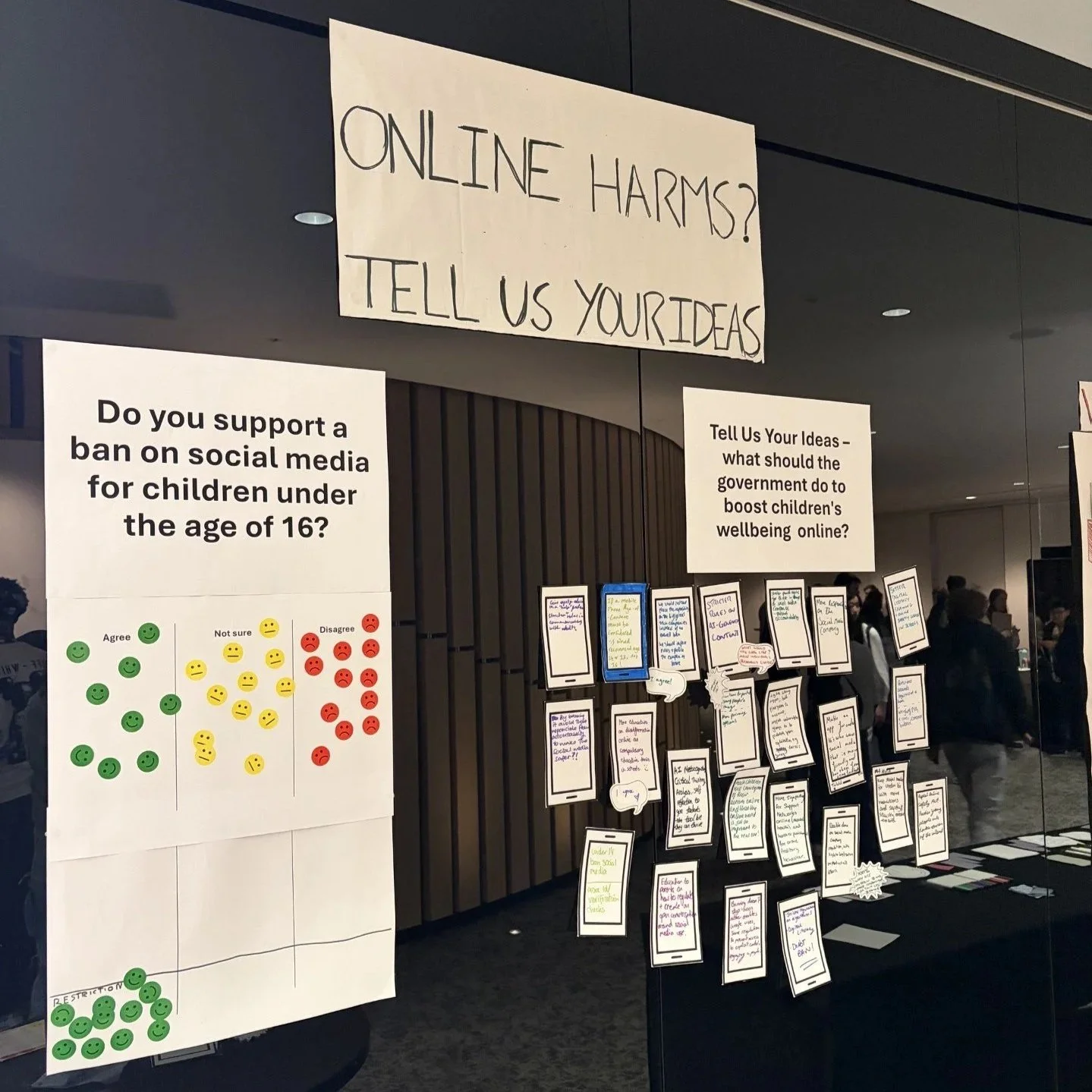
Young people shared their views at the Fair Education Youth Summit
Ryan, 21, Yorkshire:
“Some of the apps being banned, like YouTube for example, have more good than harm. Many use it as a way to study — there is so much educational content and a lot of schools use it as a way to host revision material for students... The poorest students in society suffer the most at the hand of this ban, as I wouldn't be able to access this content, but my more wealthy peers can afford to hire a private tutor.”
Ryan's point about educational inequity is one that should give policymakers pause. At FEA, we know that the resources available to young people from low-income households are already stretched. Policies designed to protect children must not inadvertently widen the gaps we are all working to close.
Sneha, 21, Midlands:
“If the government cares there would be more funding for youth clubs and accessible, FREE places for the youth. The youth are demonised in public spaces all the time. They need somewhere to go that isn't fixated on authority.”
Osob, 18, Midlands:
“Young people have already had to deal with closures of youth clubs, sports centres, well funded parks etc. and thus many have turned to social media to talk to their friends. When you take away access to digital 3rd spaces you ensure that kids have nowhere to turn.”
Imanni, 17, London:
“There's nothing for us to do: nothing affordable, no Saturday jobs, no activities to spend money on even if we are employed. Raising a generation in boredom won't keep them safe.”
This theme - that social media has filled a vacuum left by the erosion of affordable, accessible spaces for young people - came through repeatedly, and it is a challenge that goes well beyond this policy alone.
Amelia, 14, Midlands:
“Safety cannot be achieved by simply removing access. In fact, removing it may just force young people into more dangerous parts of the internet... Social media, when used responsibly, can be a powerful tool for learning, connection, and empowerment.”
Scarlett, 20, South West:
“I think it's a simplistic solution that will be hard to enforce. Also I really worry about the impacts on lots of marginalised young people who rely on social media for support, information, and community.”
Jonathan, 17, North West:
“16 year olds need to be equipped to vote, and with social media currently being a key source of political information, it's vital that the government ensures good citizenship education is introduced in all schools.”
Hayden, 21, Midlands:
“I’m very 50/50 on it. On one hand social media has so much harmful content that young people really don't need to be seeing. But it's also a sense of community and gives people an escape - say if they have a tough home life or school isn't great.”
Bilal, 20, Midlands:
“Remove social media and not only have you just taken away an app, but laughter, connection, and a source of daily entertainment.”
What unites our YSG - across all their different views - is a clear and urgent ask: that young people are included as genuine partners in the policies that shape their digital lives. Not as an afterthought, not as a consultation box to tick, but in the room where decisions are made. The government's consultation attracted over 116,000 responses, many from young people who engaged in good faith. The announcement came barely three weeks after it closed. That timeline matters and our young people noticed.
Youth-led digital agency FlippGen has written an open letter to the Prime Minister making exactly this call, which the YSG have signed. If you or your organisation would like to add your voice, you can do so here.
At FEA, we will continue to make sure that our young people's voices are part of this conversation as the legislation develops.
Becca Weighell
Head of Youth Engagement
Fair Education Alliance