
Our Theory of Change
The Fair Education Alliance exists to ensure that no child’s success is limited by their socio-economic background. Our Theory of Change sets out how our work contributes to lasting systems change in educational inequity and provides a common language that connects our day-to-day work to long-term ambition, keeping our collective effort focused on what matters most. It is the roadmap that guides our systems change work.
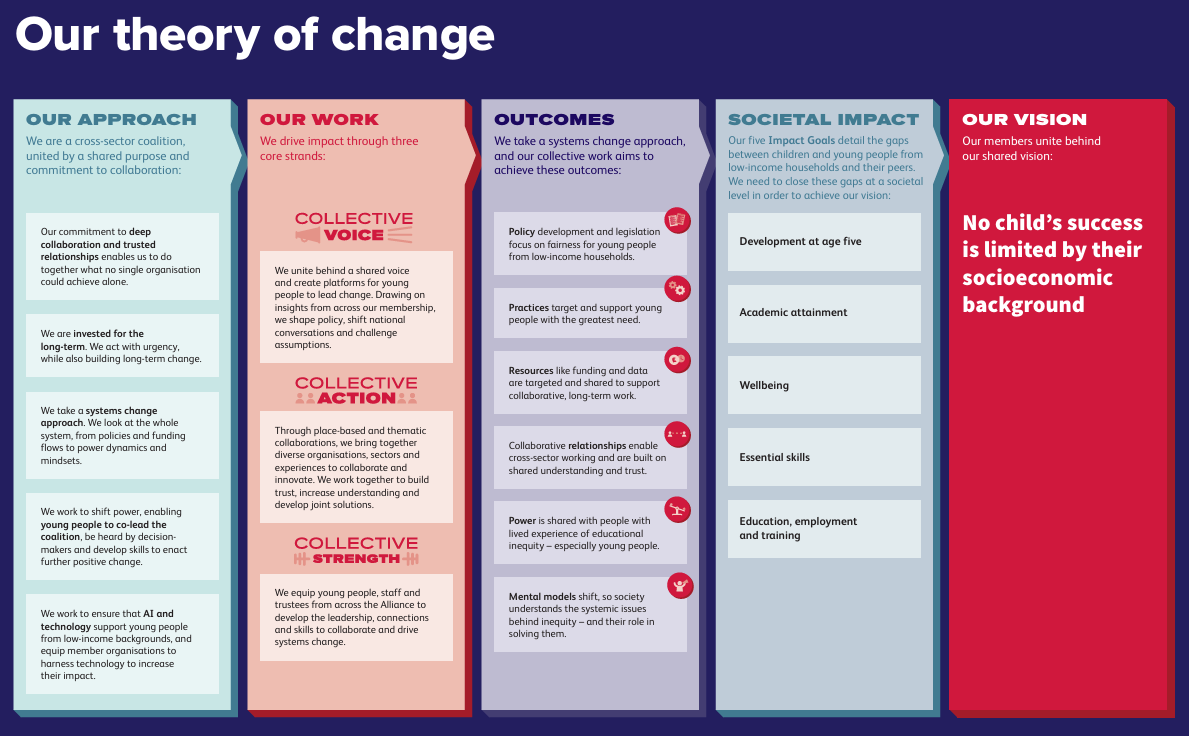
Click on the image to view our Theory of Change in more detail.
Understanding our Theory of Change
In the left two columns, we show our approach and the principles that guide how we work, as well as what we do as an alliance. This includes how we work together, and how we involve young people.
In the middle, we show the outcomes we believe we can directly influence through our activities: policies, practices, resource flows, relationships, power and mental models. These outcomes come from the Water of Systems Change framework, and represent the parts of the system that are integral to improve outcomes for children and young people.
On the right, we show the long-term sustained systems change impact goals we are working towards. If we, as an alliance, are successful in achieving our six outcomes, we expect to see the gaps close between young people from low-income backgrounds and their wealthier peers in areas such as early development, attainment, wellbeing, essential skills and access to education, employment and training. We also recognise that these long-term impact goals go beyond the work of the Fair Education Alliance and our members, and depend on wider societal conditions that sit outside our direct control. Nevertheless, they help us guide, align and inspire our collective efforts.Together, this is how we work towards our long-term vision: that no child’s success is limited by their socioeconomic background.
As with all effective Theories of Change, ours is designed to evolve. As we learn more about what works in achieving systems change, we will continue to review and refine our approach. The model provides clarity, not constraint, and supports ongoing learning and improvement.
Why does a Theory of Change matter?
Our Theory of Change helps us focus on the areas where we believe collective effort can make the greatest difference. Rather than responding only to the symptoms of inequity, we focus on shifting the underlying conditions that hold the problem in place. This ensures our work contributes to lasting systems change, not just short-term improvement. It provides a shared understanding of how change happens. It ensures that our activities are not isolated efforts, but part of a coordinated approach to shifting the conditions that hold inequity in place. It also strengthens accountability, enabling us to track progress and reflect honestly on our impact.
How do we use our Theory of Change?
At the FEA, our Theory of Change is a practical tool that guides decision-making and learning. At the FEA, our Secretariat use it to:
Design our activities so that they are aligned to the outcomes we want to achieve
Support evaluation and learning, helping us understand where progress is being made, where change is slower, and how we need to adapt our approach in response
Explain our work clearly to members, funders and other key players in the system
Encourage members’ shared ownership of impact across the Alliance